
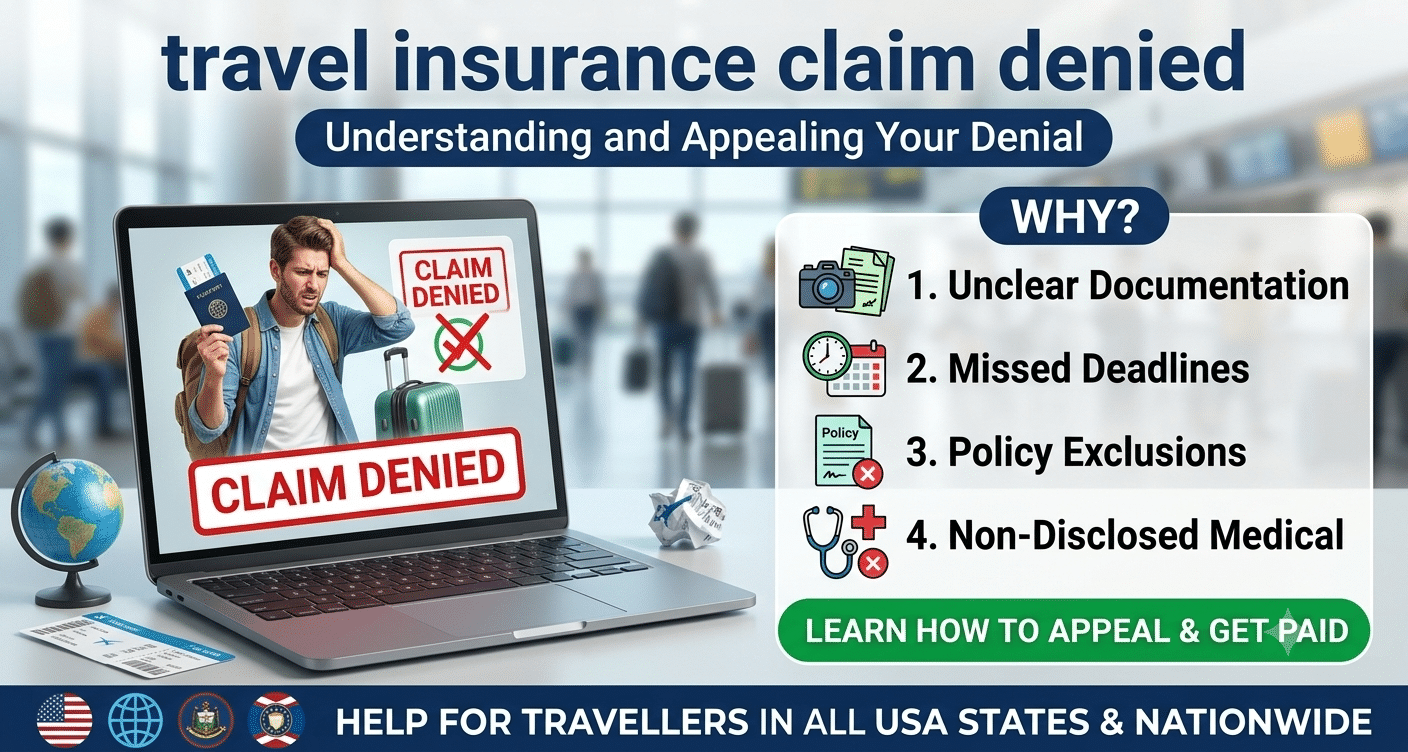
Introduction: What to Do When Your Travel Insurance Claim Is Denied
Travel insurance claim denied situations can create unexpected financial problems for American travelers. Imagine spending $6,000 on flights, hotels, rental cars and prepaid vacation activities. Unfortunately, an unexpected medical emergency forces you to cancel your trip. You submit a claim because you purchased travel insurance. However, your insurance company sends a denial letter instead of the reimbursement you expected.
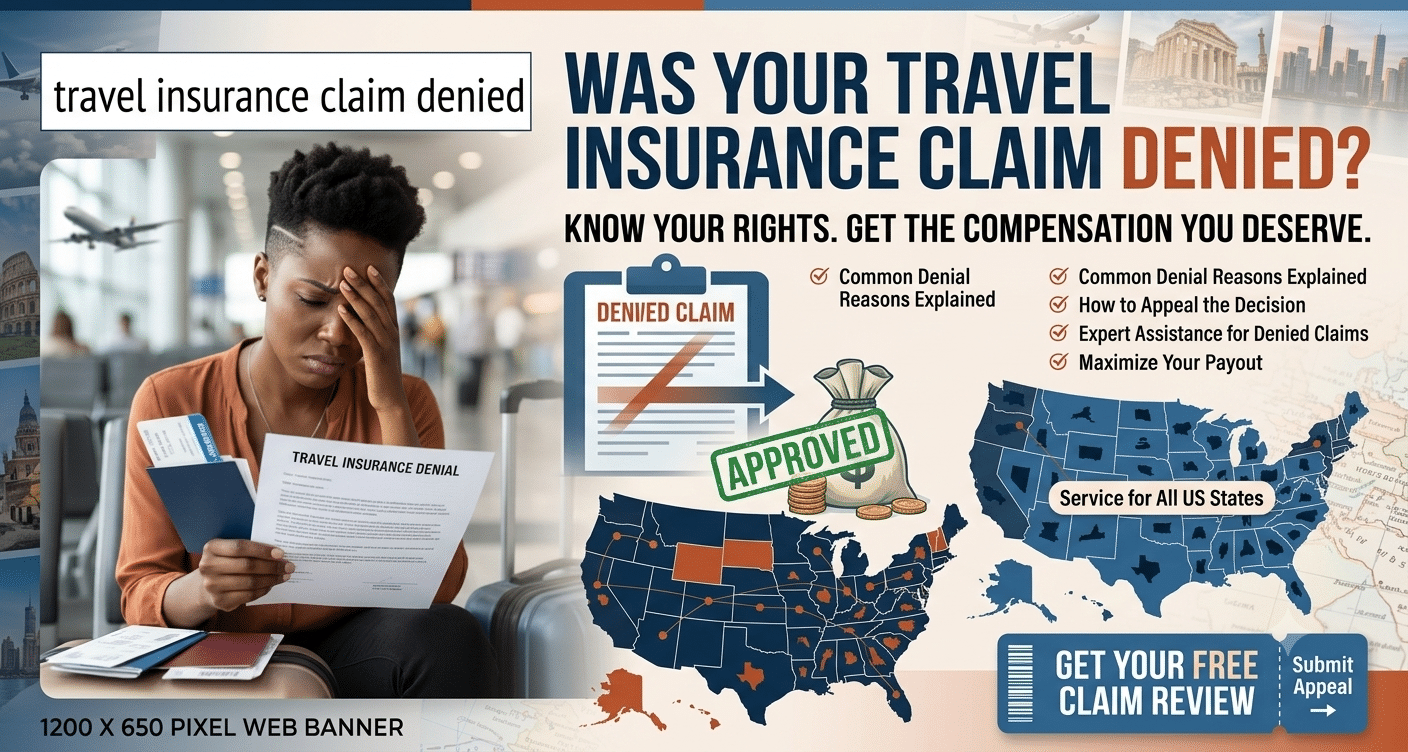
What should you do next?
First, don’t assume that the insurance company’s decision is final. A denied claim does not automatically mean that you have no right to reimbursement. Instead, you should examine the denial letter, review your policy and identify the exact reason for the rejection.
Moreover, some travel insurance claims are rejected because of missing documents, incorrect information, policy exclusions or misunderstandings about covered events. In other situations, the insurer may have interpreted the policy differently from the traveler.
Fortunately, you can take several practical steps to challenge a travel insurance claim denial. You may be able to correct an administrative error, provide additional evidence, request reconsideration or file a complaint with your state insurance department.
This comprehensive guide explains why travel insurance companies deny claims, how to appeal an insurance decision and how to protect your financial interests.
Whether you live in California, Texas, Florida, Georgia or New York, understanding your insurance policy can help you make better decisions.
Quick answer: If your travel insurance claim is denied, obtain the written explanation, identify the policy provision involved, collect supporting documents and submit a written appeal before the applicable deadline.
What Does Travel Insurance Claim Denied Mean?
A travel insurance claim denial means that an insurance company has decided not to reimburse some or all of the expenses submitted under your travel insurance policy.
However, a denial can involve different situations.
For example, your insurer might reject an entire trip cancellation claim because the reason for cancellation is excluded. Alternatively, it might approve your medical expenses but refuse to reimburse a hotel extension.
Therefore, you should determine whether the company has denied the entire claim or only certain expenses.
Full Travel Insurance Claim Denial
A full denial occurs when the insurer refuses to pay any portion of your submitted claim.
Common examples include:
- Cancelling a vacation for a reason that the policy does not cover.
- Travelling against medical advice when the policy excludes the circumstances.
- Failing to meet a pre-existing medical condition waiver requirement.
- Submitting a claim for an excluded adventure activity.
- Travelling outside the policy’s coverage dates.
Nevertheless, review the exact policy language before accepting the decision.
Partial Travel Insurance Claim Denial
A partial denial occurs when the insurer approves some expenses but rejects others.
For instance, suppose your international flight costs $1,200 and your hotel costs $2,000. Your insurer might approve the flight expense but reject the hotel because the hotel booking was refundable.
In this situation, ask the company to explain its calculation.
You should also check whether the policy covers prepaid, non-refundable expenses only.
Delayed Travel Insurance Claim Versus Denied Claim
A delayed claim and a denied claim are not the same.
A delayed claim means that the insurer has not completed its decision or payment process. A denied claim means that the company has issued a decision refusing payment.
However, an insurer may request additional documents before making a final decision.
Consequently, ask for written confirmation of your claim’s current status.
15 Common Reasons Why a Travel Insurance Claim Is Denied
Understanding the reason for rejection is the first step toward a successful appeal.
Although travel insurance companies offer different plans, several common exclusions and administrative problems can affect reimbursement.
1. Your Cancellation Reason Is Not Covered
One of the most common reasons for a denied travel insurance claim involves an uncovered cancellation reason.
Standard trip cancellation insurance usually covers specific unexpected events listed in the policy.
Depending on the plan, these may include:
- Serious illness or injury.
- Death of a covered family member.
- Certain severe weather events.
- Unexpected jury duty.
- Certain employment-related events.
- Other specifically listed emergencies.
However, changing your mind about a vacation generally does not qualify as a covered reason.
For example, imagine that you booked a $4,500 family vacation to Florida. Two weeks before departure, you decide that you would rather stay home.
Although your decision is understandable, ordinary trip cancellation coverage may not reimburse the expenses.
Possible solution: Review the covered-reasons section and determine whether another applicable provision supports your claim.
2. Pre-Existing Medical Condition Exclusion
A pre-existing medical condition can create complications when you submit a travel medical or trip cancellation claim.
Some travel insurance policies exclude expenses related to medical conditions that existed before coverage began.
For example, suppose a traveler has a heart condition before purchasing travel insurance. During an overseas vacation, the condition becomes worse and requires emergency treatment.
The insurer might investigate whether the medical emergency relates to an excluded pre-existing condition.
However, some policies offer a pre-existing medical condition waiver.
These waivers often require travelers to satisfy specific eligibility conditions, such as purchasing coverage within a specified period after making the initial trip payment.
Therefore, check:
- The policy’s definition of a pre-existing condition.
- The applicable look-back period.
- The waiver eligibility requirements.
- The purchase deadline.
- Any medical stability requirements.
Possible solution: Request the exact policy wording and provide medical records showing the relevant medical timeline.
3. Missing Medical Documents
Medical travel insurance claims frequently require supporting documentation.
For example, your insurer may request:
- Hospital admission records.
- Medical examination reports.
- Doctor’s certificates.
- Diagnosis information.
- Treatment invoices.
- Prescription records.
- Payment receipts.
Without these documents, the insurer may be unable to verify the medical emergency.
However, a missing document does not necessarily mean that your claim can never be reconsidered.
Possible solution: Ask the insurer for a complete list of missing documents. Contact the hospital or treating physician and obtain the requested records.
4. You Did Not Inform the Insurer on Time
Certain travel insurance policies require travelers to notify the assistance provider promptly after an emergency.
For example, a policy may require prior authorization before certain medical procedures or emergency transportation arrangements.
However, the requirements differ between policies.
An emergency situation may also make advance communication impossible.
Therefore, explain the circumstances and provide evidence of why you could not contact the insurer earlier.
Possible solution: Submit hospital records, emergency reports and a written explanation of the communication delay.
5. Incomplete Travel Insurance Claim Form
An incomplete claim form can delay reimbursement or create a reason for rejection.
For instance, you might accidentally enter the wrong travel date, policy number or expense amount.
Similarly, inconsistent information between your booking confirmation and claim form may require further investigation.
Before submitting an appeal, check:
- Your policy number.
- Your travel dates.
- Your destination.
- The incident date.
- The claimed amount.
- Your bank or reimbursement details.
- Your supporting documents.
Possible solution: Correct the inaccurate information and ask whether the insurer will accept a revised claim submission.
6. You Purchased Insurance After an Unforeseen Event Became Known
Travel insurance generally cannot protect travelers against every event that they already know about before purchasing coverage.
For example, suppose a major storm has already been officially named and is expected to affect your destination.
You subsequently purchase travel insurance and cancel your vacation because of that storm.
Your insurer may deny the claim because the event was already known or foreseeable when you purchased coverage.
However, the exact outcome depends on the policy wording and applicable law.
Possible solution: Establish the timeline of the event, policy purchase and cancellation. Request the insurer’s explanation of its known-event exclusion.
7. You Did Not Purchase Cancel for Any Reason Coverage
Standard trip cancellation insurance and Cancel For Any Reason coverage are different.
Standard insurance generally requires a cancellation reason listed in the policy.
By contrast, eligible Cancel For Any Reason (CFAR) coverage may reimburse a percentage of prepaid, non-refundable trip expenses when travelers cancel for a reason that ordinary coverage does not recognize.
However, CFAR coverage has important restrictions.
These may include:
- Purchasing the benefit within an eligible time window.
- Insuring the required percentage of trip expenses.
- Cancelling within a specified period before departure.
- Receiving only a percentage of eligible expenses.
For example, a plan might reimburse 50% or 75% of eligible expenses, depending on its terms.
Therefore, CFAR does not automatically provide a full refund.
8. Your Claim Involves an Excluded Adventure Activity
Some travel insurance policies exclude particular high-risk activities.
Examples may include:
- Skydiving.
- Certain mountaineering activities.
- Bungee jumping.
- Certain competitive sports.
- Off-piste skiing.
- Certain motor racing activities.
However, some insurers offer optional sports or adventure coverage.
For example, a traveler who suffers an injury while participating in an excluded activity might receive a medical claim denial.
Possible solution: Review the activity exclusion and check whether an optional sports benefit was purchased.
9. You Failed to Disclose Important Information
Insurance applications often require accurate information.
For example, a traveler may need to disclose certain existing medical conditions or other details relevant to the selected coverage.
If the insurer discovers an inaccurate or incomplete declaration, it may investigate whether the information affects coverage.
However, the legal consequences depend on the policy and applicable state law.
Possible solution: Request the insurer’s written explanation. Compare the application answers with the policy requirements and provide any relevant evidence.
10. Your Trip Was Not Covered During the Incident
Travel insurance normally applies only during specified coverage dates.
For example, suppose your policy starts on December 10, but your flight departs on December 8.
An incident occurring before the effective date might fall outside the policy.
Likewise, some policies have maximum trip-duration limits.
Possible solution: Compare the policy certificate, effective dates, departure date and incident date.
11. You Did Not Provide Proof of Financial Loss
Travel insurance companies generally require evidence of the actual expenses claimed.
For example, a traveler who requests $3,000 in reimbursement may need to provide:
- Flight invoices.
- Hotel receipts.
- Tour booking confirmations.
- Cancellation penalties.
- Refund statements.
- Proof of payment.
A booking confirmation alone may not prove that you paid the full amount.
Possible solution: Request itemized invoices and payment records from your travel providers.
12. You Received a Refund From Another Company
Travel insurance generally does not reimburse the same financial loss twice.
For example, if your airline refunds $800 for a cancelled flight, you generally cannot also recover that same $800 from your travel insurer.
Similarly, a hotel voucher or credit may affect the amount of your eligible loss, depending on the policy.
Possible solution: Submit an updated expense calculation showing refunds, credits and remaining non-refundable expenses.
13. Your Travel Delay Did Not Meet the Minimum Requirement
Some policies require a delay to reach a minimum number of hours before benefits apply.
For instance, a policy might require a covered delay of six hours.
If your flight is delayed for only three hours, the claim may not qualify.
However, other plans use different waiting periods and covered-event definitions.
Possible solution: Check the delay benefit and provide official airline documentation showing the scheduled and actual departure times.
14. You Did Not Follow the Emergency Assistance Procedure
Some policies require travelers to contact an emergency assistance provider before arranging expensive medical transportation.
This requirement can be especially important for medical evacuation claims.
Nevertheless, a genuine emergency may prevent advance approval.
Possible solution: Explain why advance authorization was impossible and provide emergency medical documentation, transport invoices and communication records.
15. The Insurer Interpreted the Policy Differently
Sometimes a claim is denied because the traveler and insurer disagree about the meaning of a particular policy provision.
For example, a traveler may believe that a family emergency qualifies for reimbursement. However, the insurer may interpret the definition of an eligible family member more narrowly.
In this situation, do not rely on assumptions.
Instead, request the exact policy wording, definition and exclusion used to make the decision.
Possible solution: Prepare a written appeal explaining why the facts satisfy the applicable policy provision.
What to Do When Your Travel Insurance Claim Is Denied
When your travel insurance claim is denied, take a systematic approach rather than immediately giving up.
The following steps can help you organize your appeal.
Step 1: Read Your Travel Insurance Denial Letter
Start by examining the official denial letter.
Look for:
- The claim number.
- The denial date.
- The reason for rejection.
- The relevant policy provision.
- Any missing documentation.
- Instructions for requesting reconsideration.
- The appeal submission deadline.
Most importantly, identify whether the insurer has rejected your claim because of an exclusion, an administrative problem or insufficient evidence.
These issues require different responses.
Step 2: Request a Detailed Explanation
If the denial letter contains unclear language, contact the insurance company’s claims department.
Ask the representative:
- What exact reason caused the denial?
- Which policy provision applies?
- What evidence did the claims examiner review?
- Can I submit additional documents?
- What is the deadline for appealing?
- Where should I send the appeal?
Request the answers in writing whenever possible.
Furthermore, record the representative’s name, date and time of each conversation.
Step 3: Obtain a Complete Copy of Your Policy
A travel insurance certificate may summarize benefits. However, the full policy wording usually contains important definitions, limitations and exclusions.
Obtain the applicable policy documents.
Review these sections carefully:
- Covered reasons.
- Exclusions.
- Definitions.
- Claim requirements.
- Documentation requirements.
- Appeal procedures.
- Coverage dates.
- Benefit limits.
- Deductibles.
- Emergency assistance requirements.
Then compare the insurer’s explanation with the actual contract.
Step 4: Collect Supporting Evidence
Evidence can make your appeal more convincing.
Depending on the claim, collect:
| Claim type | Useful supporting evidence |
| Medical emergency | Doctor’s report and hospital records |
| Trip cancellation | Cancellation confirmation and receipts |
| Flight delay | Airline delay confirmation |
| Lost baggage | Property report and receipts |
| Stolen belongings | Police report and purchase records |
| Medical evacuation | Medical recommendation and transport invoices |
| Trip interruption | Original itinerary and additional travel costs |
Keep digital and physical copies.
Additionally, arrange your documents in chronological order.
Step 5: Calculate Your Eligible Financial Loss
Do not simply request the full cost of your vacation.
Instead, calculate the amount that may qualify under your policy.
For example:
| Expense | Amount |
| Flight booking | $1,200 |
| Hotel reservation | $1,800 |
| Prepaid tour | $600 |
| Total prepaid expenses | $3,600 |
| Airline refund | -$400 |
| Hotel refund | -$200 |
| Remaining financial loss | $3,000 |
The remaining $3,000 is your potential unrecovered loss, not necessarily the amount payable under your insurance policy.
Your policy may contain additional conditions, limits or exclusions.
Step 6: Write a Formal Travel Insurance Appeal Letter
A written appeal should explain why the denial should be reconsidered.
Keep the tone professional.
Include:
- Your full name.
- Policy number.
- Claim number.
- Date of loss.
- Original denial date.
- Reason you disagree.
- Relevant policy wording.
- Supporting evidence.
- Requested outcome.
Avoid emotional language and unsupported accusations.
Instead, present a clear timeline and explain how the evidence supports coverage.
Step 7: Submit the Appeal Before the Deadline
Your travel insurance policy should explain how to challenge a denial.
The appeal deadline may depend on the policy, insurer and applicable state law.
Therefore, never assume that every travel insurance appeal has the same deadline.
Submit the appeal using the required method.
If you send it by email or an online portal, save the confirmation. If you use postal mail, consider a trackable delivery service.
Step 8: Request a Written Appeal Decision
After submitting your appeal, ask the company to confirm receipt.
Keep a record of:
- Submission date.
- Delivery confirmation.
- Documents submitted.
- Communication history.
- Appeal reference number.
If the insurer requests additional evidence, respond promptly.
Finally, request the final decision in writing.
How to Write a Travel Insurance Claim Appeal Letter
A strong appeal letter should be factual, organized and supported by evidence.
You do not need complicated legal language.
The following example can help you prepare your own appeal.
Travel Insurance Claim Denial Appeal Letter Template
Subject: Formal Appeal Against Travel Insurance Claim Denial
Dear Claims Manager,
I am writing to formally appeal the denial of my travel insurance claim.
My policy number is [Policy Number], and my claim reference is [Claim Number].
I received your denial notification dated [Date]. According to the letter, my claim was rejected because of [Reason for Denial].
I respectfully request a reconsideration of this decision.
The incident occurred on [Date] during my covered trip. The circumstances were as follows:
[Explain the incident clearly and provide a chronological account.]
I believe the claim deserves further consideration because [Explain how the circumstances meet the relevant policy provision].
To support my appeal, I have attached the following documents:
- Travel insurance policy certificate.
- Original denial letter.
- Medical or incident documentation.
- Booking confirmations.
- Receipts and payment records.
- Additional supporting evidence.
Please review the attached information and provide a written explanation of your reconsideration decision.
If you maintain the denial, please identify the exact policy language supporting that decision and explain how it applies to the facts of my claim.
Thank you for your attention.
Sincerely,
[Full Name]
[Contact Information]
[Policy Number]
[Claim Reference]
Important: Replace every bracketed section with accurate information. Do not include documents that do not relate to your claim.
Travel Insurance Claim Denied Because of Medical Expenses
Medical emergencies are among the most financially significant travel insurance problems.
An unexpected hospital admission in another country can result in substantial expenses.
For example, a traveler from California visiting Europe might require emergency treatment following an accident.
The traveler may submit a medical claim after returning home. However, the insurer might reject the claim because of missing medical records, an exclusion or a prior authorization requirement.
Why Travel Medical Insurance Claims Are Denied
Common reasons include:
- Pre-existing medical condition exclusions.
- Treatment outside the policy’s coverage.
- Missing hospital invoices.
- Incomplete diagnosis information.
- Failure to satisfy notification requirements.
- Excluded activities.
- Treatment that does not meet the policy’s definition of emergency care.
How to Appeal a Denied Medical Travel Insurance Claim
First, request the insurer’s medical claims assessment.
Next, obtain the hospital’s complete records.
Ask the treating doctor to clarify:
- The medical diagnosis.
- When symptoms started.
- Why treatment was necessary.
- Whether the situation was an emergency.
- What treatment was provided.
Additionally, request itemized bills and proof of payment.
If the denial concerns a pre-existing condition, compare the medical timeline with the policy’s definition and look-back period.
Money-saving tip: Ask the hospital whether it can provide an itemized invoice. This may help identify billing errors and clarify the expenses submitted to your insurer.
Travel Insurance Claim Denied for Trip Cancellation
Trip cancellation coverage is designed to protect eligible prepaid travel expenses when a covered event prevents a traveler from starting a trip.
However, not every cancellation qualifies.
For example, cancelling because of an unexpected serious illness may qualify under certain policies. Cancelling because you found a cheaper vacation may not.
Common Trip Cancellation Claim Problems
| Cancellation reason | Possible coverage |
| Serious unexpected illness | Often covered if policy conditions are met |
| Death of an eligible family member | Often covered |
| Ordinary change of mind | Generally excluded |
| Financial difficulty | Generally excluded |
| Severe weather | Depends on the policy |
| Airline schedule change | Depends on the policy and circumstances |
| Pre-existing condition | Depends on exclusions and waiver |
| Work-related emergency | Only if the policy includes it |
These are general examples, not guaranteed coverage decisions.
What Evidence Should You Provide?
Depending on the reason, provide:
- Medical certificates.
- Death certificates.
- Employer documentation.
- Airline cancellation notices.
- Government travel restrictions.
- Hotel cancellation statements.
- Refund confirmations.
The evidence should directly support the covered event.
Travel Insurance Claim Denied for Flight Delays and Cancellations
Flight disruptions can affect hotel reservations, connecting flights and prepaid activities.
However, airline compensation and travel insurance reimbursement are separate matters.
For example, your airline might offer a refund or rebooking option. Your travel insurer may provide additional benefits if the policy covers the circumstances.
Why Flight Delay Claims Are Rejected
Possible reasons include:
- The delay did not meet the minimum waiting period.
- The cause of delay was excluded.
- The traveler did not provide official airline documentation.
- The claimed expenses exceeded the benefit limit.
- The traveler did not incur an eligible expense.
Documents Needed for a Flight Delay Appeal
Keep the following:
- Original flight itinerary.
- Boarding pass.
- Airline delay confirmation.
- Updated departure information.
- Hotel invoices.
- Meal receipts, where eligible.
- Proof of additional expenses.
Compare your claimed expenses with the policy’s travel delay benefit.
Travel Insurance Claim Denied in California, Texas, Florida, Georgia and New York
Travel insurance is available to consumers throughout the United States. However, state insurance regulations and complaint procedures can differ.
If your insurer denies a claim, your state insurance department may provide consumer assistance.
California Travel Insurance Claim Denied
California consumers can contact the California Department of Insurance for assistance with insurance complaints.
If you believe your insurer has incorrectly denied a covered claim, organize your policy, denial letter and supporting evidence.
Start by attempting to resolve the issue directly with the insurer.
If the problem remains unresolved, review the department’s consumer complaint process.
Official resource: California Department of Insurance — https://www.insurance.ca.gov/
Texas Travel Insurance Claim Denied
Texas travelers can seek consumer assistance from the Texas Department of Insurance.
Before filing a complaint, collect:
- Your policy certificate.
- Claim reference.
- Denial letter.
- Supporting receipts.
- Appeal correspondence.
Explain why you believe the insurer’s decision conflicts with the policy.
Official resource: Texas Department of Insurance — https://www.tdi.texas.gov/
Florida Travel Insurance Claim Denied
Florida travelers should carefully review the travel insurance contract, especially cancellation exclusions and hurricane-related provisions.
For example, some policies distinguish between a storm that becomes known before coverage begins and an unexpected event occurring after coverage starts.
If you believe the company has incorrectly interpreted the policy, contact the Florida Department of Financial Services.
Official resource: Florida Department of Financial Services — https://www.myfloridacfo.com/
Georgia Travel Insurance Claim Denied
Georgia consumers can contact the Georgia Office of Commissioner of Insurance and Safety Fire.
Prepare a written explanation describing the claim, denial reason and steps already taken to resolve the issue.
Official resource: Georgia Office of Commissioner of Insurance — https://oci.georgia.gov/
New York Travel Insurance Claim Denied
New York travelers can seek assistance from the New York State Department of Financial Services.
The department provides insurance consumer resources and complaint procedures.
When submitting a complaint, provide a clear timeline and copies of relevant documents.
Official resource: New York State Department of Financial Services — https://www.dfs.ny.gov/
Why State Insurance Departments Matter
A state insurance department can investigate certain complaints involving unfair claim handling, delays or potential violations of insurance requirements.
However, a regulator does not automatically guarantee reimbursement.
The department also does not replace a private attorney or act as your personal legal representative.
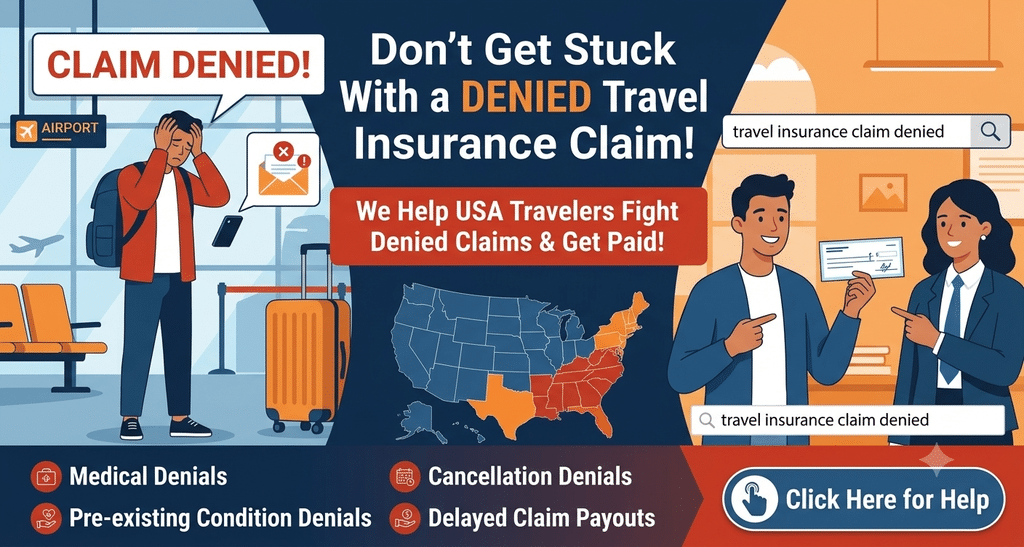
Travel Insurance Claim Denied vs. Approved: Understanding Your Financial Options
Before challenging a claim, understand what the policy actually covers.
Different travel insurance benefits address different financial risks.
| Coverage type | Main purpose | Important limitation |
| Trip cancellation | Eligible prepaid expenses before departure | Covered reasons apply |
| Trip interruption | Certain unused trip expenses and additional costs | Benefit conditions apply |
| Travel medical | Eligible medical expenses abroad | Exclusions and limits apply |
| Emergency evacuation | Eligible emergency transportation | Authorization rules may apply |
| Travel delay | Certain additional expenses | Minimum delay may apply |
| Baggage loss | Eligible lost or damaged belongings | Item and overall limits apply |
| Baggage delay | Certain essential replacement purchases | Waiting periods may apply |
| CFAR | Eligible cancellation for broader reasons | Partial reimbursement and purchase rules |
Standard Travel Insurance vs. Cancel For Any Reason Coverage
| Feature | Standard trip cancellation | CFAR |
| Covered cancellation reasons | Listed events | Broader eligible reasons |
| Change of mind | Usually excluded | May qualify |
| Reimbursement | Up to applicable limits | Usually a percentage |
| Purchase deadline | Policy-specific | Often time-sensitive |
| Eligibility | Policy-specific | Additional conditions |
CFAR is not the same as unrestricted cancellation protection.
Read the policy before purchasing it.
How Much Money Can You Recover After a Travel Insurance Claim Denial?
The amount you may recover depends on the policy, covered event, eligible expenses and applicable limits.
Let’s examine a practical calculation.
Example 1 – Family Vacation Cancellation
Suppose a family from Texas books a vacation with the following expenses:
| Expense | Amount |
| Flights | $1,800 |
| Hotels | $2,400 |
| Prepaid tours | $800 |
| Rental car | $500 |
| Total trip cost | $5,500 |
The family later receives a partial refund of $700.
Therefore:
Total prepaid expenses = $5,500
Less refunds = $700
Potential unrecovered expenses = $4,800
If the policy covers the cancellation and the remaining expenses qualify, the insurer may reimburse an eligible amount up to the applicable benefit limit.
However, if the cancellation reason is excluded, the claim may be denied.
Example 2 – CFAR Reimbursement Calculation
Suppose a traveler has:
- Eligible non-refundable trip expenses: $4,000.
- Applicable CFAR reimbursement percentage: 75%.
Calculation:
$4,000 × 75% = $3,000.
The potential reimbursement is $3,000 before applying any additional policy conditions or limitations.
The remaining $1,000 would not be reimbursed under that assumed percentage.
Example 3 – Medical Emergency
Suppose a traveler incurs:
| Medical expense | Amount |
| Emergency consultation | $250 |
| Hospital treatment | $1,500 |
| Medication | $150 |
| Diagnostic tests | $400 |
| Total | $2,300 |
If the policy covers the emergency and the expenses meet its conditions, the traveler may qualify for reimbursement.
Nevertheless, deductibles, benefit limits and exclusions can change the final payment.
Use This Simple Travel Insurance Calculation
Potential eligible loss = Covered expenses − Refunds − Other recoveries
This calculation helps organize your financial records.
It does not establish that every remaining expense is covered.
Can You Sue a Travel Insurance Company for Denying Your Claim?
In some situations, a traveler may consider legal action after an unsuccessful appeal.
However, a claim denial does not automatically mean that the insurer has broken the law.
The relevant questions include:
- Does the policy cover the event?
- Did the insurer follow the contract?
- Was the denial supported by the policy wording?
- Did the insurer comply with applicable state requirements?
- Did the company adequately explain its decision?
When Should You Speak With an Insurance Attorney?
Consider consulting an attorney when:
- A substantial claim has been denied.
- The insurer appears to have ignored important evidence.
- The policy language is disputed.
- The company has failed to follow applicable procedures.
- You suspect an unfair claims practice.
- You are approaching a legal filing deadline.
An attorney can review the policy and assess the available options.
What Does a Travel Insurance Claim Attorney Cost?
Legal fees depend on the lawyer, location, complexity and type of legal service.
Some attorneys charge hourly fees. Others may offer a fixed-fee consultation or another fee arrangement.
Before hiring an attorney, ask:
- Have you handled travel insurance disputes?
- What are your fees?
- What expenses could arise?
- Is there a limitation period?
- What are the possible outcomes?
Explore your legal options: If you believe your travel insurer has improperly denied a significant claim, consider obtaining independent legal advice before accepting the decision.
How to File a Travel Insurance Complaint in the United States
If your insurer does not resolve the issue after you submit an appeal, you may be able to file a complaint with your state insurance department.
The National Association of Insurance Commissioners provides information about contacting state insurance regulators.
Step 1 – Contact the Insurance Company
Explain the problem and request a written response.
Step 2 – Gather Your Records
Prepare your policy, denial letter, appeal, receipts and communication history.
Step 3 – Identify the Appropriate Regulator
Use the insurance department in the relevant state.
Step 4 – Submit a Factual Complaint
Explain the timeline, claim amount, denial reason and why you disagree.
Step 5 – Follow the Regulator’s Instructions
The department may request additional documents or forward the complaint to the insurer.
However, the regulator’s authority varies by state.
For general guidance, visit the NAIC consumer complaint resource:
How to Avoid Travel Insurance Claim Denials Before Your Next Trip
Prevention starts before purchasing your policy.
Although no insurance plan guarantees that every future expense will be reimbursed, careful preparation can reduce avoidable problems.
Compare Travel Insurance Coverage Carefully
Do not choose a policy based only on its price.
Compare:
- Emergency medical limits.
- Medical evacuation limits.
- Trip cancellation benefits.
- Trip interruption coverage.
- Baggage protection.
- Travel delay benefits.
- Pre-existing condition provisions.
- Adventure activity exclusions.
- Deductibles.
- Maximum trip duration.
Buy Travel Insurance at the Right Time
Some benefits require early purchase.
For example, a pre-existing condition waiver or CFAR benefit may have a limited purchase window.
Consequently, compare the terms when you make your initial trip deposit.
Declare Relevant Medical Information
Answer insurance application questions accurately.
If you are unsure whether a medical condition must be disclosed, ask the insurer before purchasing coverage.
Keep written confirmation of important coverage discussions.
Save All Travel Documents
Create a digital folder containing:
- Insurance certificate.
- Complete policy wording.
- Flight tickets.
- Hotel reservations.
- Receipts.
- Medical documents.
- Emergency assistance details.
- Claim forms.
You can also keep a backup copy in a secure cloud account.
Contact Emergency Assistance When Appropriate
Save the insurer’s assistance number before departure.
If you experience a medical emergency, contact the assistance provider when reasonably possible.
However, never delay urgent medical treatment simply to obtain insurance authorization.
Read the Exclusions Before You Travel
Pay special attention to:
- Pre-existing conditions.
- Alcohol-related incidents.
- Certain adventure sports.
- Known events.
- Unattended baggage.
- Travel against medical advice.
- Destination restrictions.
Understanding these conditions can help you avoid unpleasant surprises.
How to Choose the Best Travel Insurance for International Trips
Travelers from the United States have different insurance needs.
A family visiting Europe may prioritize emergency medical coverage. Meanwhile, an adventure traveler may need additional sports protection.
Therefore, compare plans according to your actual travel risks.
Best Travel Insurance for Families
Families should consider:
- Emergency medical protection.
- Coverage for eligible family emergencies.
- Trip interruption benefits.
- Baggage protection.
- Child-related provisions.
- Medical evacuation.
Best Travel Insurance for Seniors
Older travelers should pay close attention to:
- Age eligibility.
- Medical stability requirements.
- Pre-existing condition waivers.
- Emergency medical limits.
- Medical evacuation coverage.
- Prescription-related exclusions.
Best Travel Insurance for International Business Trips
Business travelers may need:
- International medical protection.
- Emergency transportation.
- Travel delay benefits.
- Baggage coverage.
- Coverage for eligible business equipment.
- Flexible trip arrangements.
Best Travel Insurance for Adventure Travel
Adventure travelers should verify whether their planned activities qualify.
Do not assume that every recreational activity is automatically covered.
Ask the insurer for written clarification if the policy wording is unclear.
High-Value Travel Insurance Terms Every Traveler Should Understand
Insurance terminology can be confusing.
Understanding these terms can help you compare coverage and avoid claim problems.
| Term | Meaning |
| Premium | Amount paid for insurance |
| Deductible | Eligible expense you must pay before insurance contributes |
| Exclusion | Situation or expense not covered |
| Benefit limit | Maximum amount available under a benefit |
| Pre-existing condition | Medical condition defined under the policy |
| CFAR | Cancel For Any Reason benefit |
| Claim | Request for payment under insurance |
| Reimbursement | Money paid for eligible expenses |
| Policyholder | Person who owns or holds the policy |
| Covered event | Event that meets the policy’s requirements |
What Is a Travel Insurance Deductible?
A deductible is the amount you may need to pay before the insurer contributes to eligible expenses.
For example, if an eligible claim is $1,000 and the deductible is $100, the potential payment is $900, assuming no other limitations apply.
What Is a Travel Insurance Benefit Limit?
A benefit limit is the maximum amount payable under a particular coverage section.
For example, a baggage benefit may have a maximum limit of $1,500.
Even if your luggage contains $3,000 worth of belongings, the policy may not reimburse the full value.
Realistic Travel Insurance Claim Scenarios and Lessons
The following are illustrative scenarios, not verified customer testimonials.
They demonstrate how different policy terms can affect reimbursement.
Scenario 1 – A California Traveler Faces a Medical Emergency
A traveler from California purchases international travel insurance before visiting Italy.
During the trip, the traveler experiences severe abdominal pain and receives emergency hospital treatment.
After returning home, the traveler submits medical bills.
However, the insurer requests additional medical records to determine whether the condition existed before coverage began.
Lesson: Travelers should retain medical records and carefully review pre-existing condition provisions.
Scenario 2 – A Texas Family Cancels a Vacation
A family from Texas books a prepaid vacation costing $5,000.
Before departure, the family decides to cancel because of a change in personal plans.
The standard trip cancellation policy does not list that reason as a covered event.
Lesson: Standard cancellation insurance does not automatically provide reimbursement for every personal decision. Eligible CFAR coverage may offer broader protection.
Scenario 3 – A Florida Traveler Experiences a Hurricane Disruption
A traveler plans a vacation in Florida during hurricane season.
A storm develops and affects travel arrangements.
The traveler submits a claim for cancellation expenses.
However, the insurer examines when the storm became a known event and whether the policy covers the specific circumstances.
Lesson: Purchase timing, covered-event definitions and hurricane exclusions matter.
Scenario 4 – A New York Traveler Misses a Connecting Flight
A traveler from New York misses a connecting flight after an earlier flight experiences a significant delay.
The traveler pays for an additional hotel night.
The insurance company requests airline documentation and hotel receipts.
Lesson: Keep evidence of the original itinerary, actual delay and additional expenses.
Frequently Asked Questions About Travel Insurance Claim Denied
A travel insurance claim may be denied when the circumstances do not meet the policy’s coverage requirements. Common reasons include pre-existing medical conditions, missing documentation, excluded activities, late notification, uncovered cancellation reasons and incorrect claim information. Additionally, some policies exclude events that were already known when coverage was purchased. Review the denial letter and identify the exact policy exclusion before deciding whether to appeal.
If your travel insurance claim is denied, follow these steps:
Obtain the official denial letter.
Ask the insurer for a detailed explanation.
Review the policy exclusions and coverage limits.
Collect receipts, medical reports and booking confirmations.
Calculate your eligible unrecovered expenses.
Submit a written appeal before the applicable deadline.
Request a written decision.
If the insurer does not resolve your complaint, contact your state insurance department for assistance.
You can appeal by sending a formal written request to your insurance company’s claims department. Include your policy number, claim reference, denial letter and an explanation of why you believe the decision is incorrect. Furthermore, attach supporting evidence such as medical certificates, airline confirmations, hotel receipts and payment records. Ask the insurer to identify the exact policy wording used to reject your claim. Always follow the appeal instructions and deadlines in your policy.
The most common reasons include:
Pre-existing medical condition exclusions.
Uncovered trip cancellation reasons.
Missing medical records.
Late claim notification.
Incorrect information on claim forms.
Excluded adventure activities.
Insufficient proof of financial loss.
Claims outside the policy dates.
Failure to meet travel delay requirements.
Expenses already reimbursed by another provider.
However, each claim depends on its specific policy terms and circumstances.
How long do I have to appeal a travel insurance claim denial?
There is no single deadline that applies to every travel insurance policy. The time limit depends on the policy, applicable state law and the type of dispute. Check your denial letter and contract immediately.
Why do travel insurance companies deny medical claims?
Common reasons include pre-existing condition exclusions, missing medical records, uncovered treatments, incomplete documentation and failure to satisfy policy requirements.
Can I get my money back after a travel insurance claim is denied?
Possibly. If the insurer made an error or additional evidence establishes coverage, it may reconsider the decision. You may also qualify for refunds from airlines, hotels or other travel providers.
Can I sue an insurance company for denying my travel claim?
Depending on the circumstances, legal action may be an option. However, the denial alone does not establish wrongdoing. Consider speaking with an attorney who understands insurance disputes and applicable state law.
Does travel insurance cover cancellation because I changed my mind?
Standard trip cancellation coverage generally requires a covered reason. However, eligible Cancel For Any Reason coverage may provide partial reimbursement for qualifying cancellations.
Can an insurance company deny a claim because I submitted documents late?
A policy may contain notification and documentation requirements. Whether a late submission justifies denial depends on the contract, circumstances and applicable law. Ask the insurer to explain its decision.
What happens if my travel insurance appeal is rejected?
You can request the final explanation, examine the applicable policy wording and consider filing a complaint with your state insurance department. For a significant dispute, consult an insurance attorney.
How can I prevent a travel insurance claim denial?
Read the complete policy, disclose relevant information accurately, understand exclusions, purchase coverage at the appropriate time and keep receipts, medical documents and booking confirmations.
E-E-A-T: Why Reliable Travel Insurance Information Matters
Travel insurance decisions can affect a family’s finances, medical care and ability to recover unexpected travel expenses.
Therefore, trustworthy information matters.
At WanderSure Coverage, our goal is to help travelers understand insurance terminology, compare available protection and make informed decisions.
Experience
Practical travel insurance examples can help readers understand how policy provisions may affect real-world situations.
However, illustrative scenarios should never be presented as genuine customer experiences.
Travelers should consult their own policy and retain original claim documents.
Expertise
Insurance decisions require careful attention to policy definitions, exclusions, benefit limits and claim requirements.
Readers should obtain clarification directly from their insurer when coverage is uncertain.
For complex disputes, an appropriately qualified insurance professional or attorney may provide additional guidance.
Authoritativeness
This article references consumer information from the National Association of Insurance Commissioners, the Centers for Disease Control and Prevention, the US Department of State and state insurance regulators.
These organizations provide useful information about insurance policies, consumer complaints and travel protection.
Trustworthiness
We aim to explain both the benefits and limitations of travel insurance.
No policy should be described as guaranteeing reimbursement for every emergency.
Likewise, readers should compare the actual contract rather than relying entirely on promotional descriptions.
Editorial disclosure: This article provides general educational information. It is not legal, financial or insurance advice. Coverage and consumer rights depend on the policy, insurer and applicable jurisdiction.
Final Checklist Before Submitting Your Travel Insurance Appeal
Before sending your appeal, review this checklist.
Obtain the official denial letter.
Confirm your policy and claim numbers.
Identify the exact denial reason.
Read the applicable policy provision.
Check the appeal deadline.
Collect medical and travel documents.
Obtain original receipts.
Calculate refunds and remaining expenses.
Prepare a factual appeal letter.
Submit the appeal using the required method.
Save proof of submission.
Request a written decision.
Conclusion: Do Not Give Up After a Travel Insurance Claim Denial
A travel insurance claim denied decision can be frustrating, especially when you have already experienced a medical emergency, cancelled vacation or expensive travel disruption.
However, you should not automatically assume that the insurer’s first decision is the final answer.
Start by reviewing your denial letter. Next, compare the explanation with your actual policy wording. Then, collect supporting evidence and submit a clear written appeal before the applicable deadline.
If the problem remains unresolved, contact your state insurance department to understand your consumer complaint options.
Most importantly, remember that travel insurance coverage depends on the contract. Careful policy comparison, accurate information and proper documentation can reduce the risk of future claim disputes.
Protect your next trip with better information. Explore the travel insurance resources at WanderSure Coverage to learn more about travel protection, insurance coverage and practical ways to prepare for unexpected travel expenses.
Sources and References
The following authoritative resources can help readers verify travel insurance information and find additional consumer guidance.
- National Association of Insurance Commissioners (NAIC) – Travel Insurance
https://content.naic.org/insurance-topics/travel-insurance
General information about travel insurance coverage, common exclusions and consumer considerations. - NAIC – How to File an Insurance Complaint
https://content.naic.org/consumer/how-to-file-complaint
Information about contacting state insurance departments when an insurer unfairly delays or denies a claim. - Centers for Disease Control and Prevention (CDC) – Travel Insurance and Medical Evacuation Insurance
https://www.cdc.gov/yellow-book/hcp/health-care-abroad/travel-insurance.html
Guidance about overseas medical care, medical evacuation, documentation and pre-existing conditions. - US Department of State – Travel Insurance
https://travel.state.gov/en/international-travel/planning/guidance/insurance.html
Guidance on selecting travel protection and checking coverage for international travel. - Florida Department of Financial Services – Travel Insurance Overview
https://www.myfloridacfo.com/division/consumers/understanding-insurance/travel-insurance-overview
Consumer guidance about travel insurance exclusions, cancellation and policy documents. - Michigan Department of Insurance and Financial Services – Travel Insurance
https://www.michigan.gov/difs/consumers/insurance/other-insurance/travel-insurance
Information about covered cancellation reasons, policy exclusions and insurance considerations. - Massachusetts Division of Insurance – Travel Insurance
https://www.mass.gov/info-details/travel-insurance
Information about pre-existing medical conditions, overseas medical protection and cancellation benefits.
Disclaimer: Government and regulatory information should be checked directly for the latest requirements. State-specific complaint procedures and insurance laws may change.

Karthick is the Founder of Wandersure Coverage, a travel and insurance-focused blog helping global travelers make smarter decisions.
Based in Chennai, India, Karthick has several years of experience researching international travel, travel insurance policies, and legal resources such as accident attorneys in the United States. He has published 700+ articles covering travel packages, insurance guides, and trip planning tips.
While not a licensed insurance broker or attorney, Karthick spends extensive time analyzing policy terms, coverage details, and real-world travel scenarios. His goal is to simplify complex information into clear, practical advice so travelers can stay protected and travel with confidence.
He regularly updates content to reflect the latest travel rules, insurance policies, and legal guidelines for international travelers.