
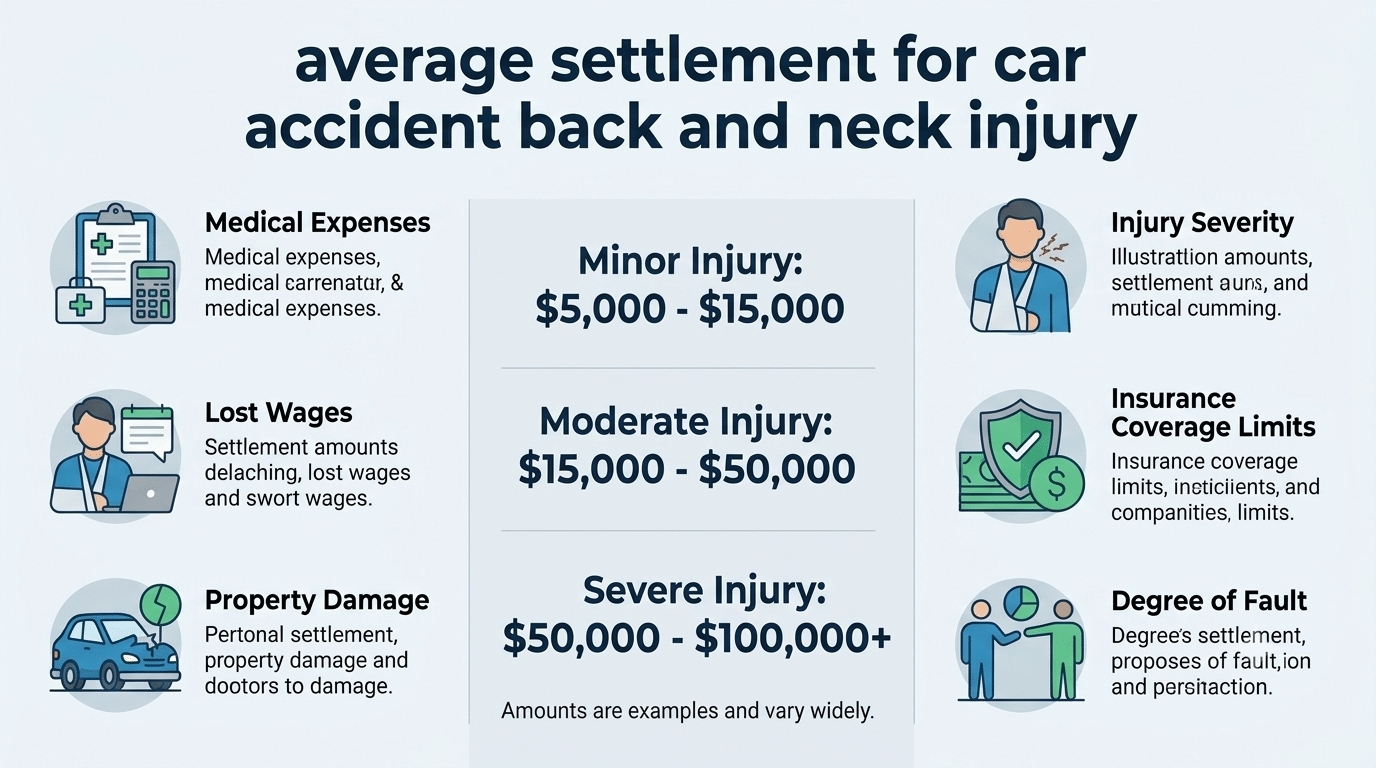
The average settlement for car accident back and neck injury depends on the severity of your injuries, medical expenses, lost income, recovery time, available insurance coverage, and the evidence supporting your claim. If you suffered whiplash, a neck strain, a herniated disc, or persistent back pain after a New York car accident, understanding these factors can help you evaluate your options. You may also want to know whether steroid injections increase settlement value, how much compensation you could receive, and when an insurance offer deserves closer attention. This guide explains New York’s no-fault insurance rules, potential compensation, settlement calculations, and practical steps for protecting your claim. It also identifies questions to discuss with a qualified New York personal injury attorney before accepting an offer.
💰 Injured in a New York Car Accident? Understand Your Claim’s Potential Value
Neck pain, back injuries, medical bills, and lost wages can make recovery stressful. Learn which factors may influence your average settlement for car accident back and neck injury, including injury severity, medical records, insurance coverage, and New York’s serious-injury rules.
Don’t accept an insurance offer without understanding your options. Review the evidence, understand your potential losses, and consider speaking with a qualified New York personal injury attorney.
Explore Your Settlement Options
What Is the Average Settlement for Car Accident Back and Neck Injury in New York?
There is no single, reliable statewide average that accurately predicts what every injured person will receive. Settlement amounts vary widely because a temporary muscle strain differs substantially from a documented disc injury that causes lasting pain, restricted movement, or nerve symptoms.
Online settlement figures can provide context, but they rarely tell the whole story. Some figures describe jury verdicts rather than negotiated settlements. Others highlight exceptional cases without explaining the medical evidence, insurance limits, or legal issues involved.
Therefore, consider your individual circumstances before relying on a published dollar amount.
What settlement amounts might different injuries involve?
The following table offers an illustrative framework for understanding how injury severity can affect a claim. These are not verified New York settlement averages, guaranteed payouts, or legal valuation ranges. They are examples of claim categories, not predictions of what an insurer or court will award.
| Injury scenario | Factors that may affect compensation | Important consideration |
| Mild neck strain | Short recovery, limited treatment, temporary discomfort | New York’s serious-injury threshold may limit pain-and-suffering claims |
| Whiplash with ongoing symptoms | Treatment duration, restricted movement, medical documentation | Consistent records help establish the effects of the injury |
| Back strain with missed work | Lost wages, treatment costs, recovery time | No-fault benefits may cover eligible economic losses |
| Herniated or bulging disc | Objective findings, nerve symptoms, functional limitations | Imaging alone does not determine the value of a claim |
| Serious spinal injury | Long-term impairment, surgery, future care, lost earning capacity | Legal eligibility, causation, and insurance coverage remain important |
The key point is simple: a diagnosis alone does not establish settlement value. Two people with similar MRI findings can experience very different symptoms, require different treatment, and face different financial consequences.
Why do published settlement figures differ?
First, settlement reports may cover different types of injuries. A case involving a short-lived strain cannot be compared fairly with a case involving spinal surgery.
Second, the reported amounts may represent different stages of a claim. A settlement before a lawsuit may differ from a verdict following a trial. Legal appeals, reductions, and negotiated resolutions can also affect reported figures.
Finally, insurance limits matter. Even a claim with substantial documented damages can face practical recovery limits when the responsible party has insufficient coverage and no other applicable source of compensation exists.
For these reasons, use online figures as background information rather than as a promise of what your claim is worth.
How New York’s No-Fault Insurance System Affects Back and Neck Injury Claims
New York uses a no-fault auto insurance system for many motor vehicle injury claims. This system can help cover eligible medical expenses and lost earnings without requiring an injured person to prove that another driver caused the accident.
However, no-fault benefits and a personal injury settlement serve different purposes.
The New York State Department of Financial Services explains that basic personal injury protection, or PIP, generally provides up to $50,000 per eligible injured person for covered basic economic losses. Benefits have specific rules and limits. https://www.dfs.ny.gov/consumers/auto_insurance/Auto_resource_center
What does basic no-fault insurance cover?
Depending on eligibility and the applicable policy, basic no-fault benefits can cover:
- Reasonable and necessary accident-related medical expenses.
- Eligible lost earnings, subject to statutory limits.
- Certain necessary expenses, such as transportation to medical appointments.
- Other covered expenses that satisfy applicable requirements.
Basic lost-earnings benefits generally cover 80% of eligible lost earnings, up to $2,000 per month for a maximum of three years, subject to the law’s conditions and offsets. Certain other necessary expenses may qualify for reimbursement up to $25 per day for one year.
These benefits do not automatically compensate you for every financial loss. They also do not independently establish your right to recover pain-and-suffering damages.
Why is the 30-day no-fault deadline important?
New York generally requires written notice of a no-fault claim within 30 days after the accident, unless an applicable exception or legally sufficient justification applies.
Missing this deadline can create serious problems. Therefore, contact the appropriate insurer promptly, request the required forms, and keep copies of everything you submit.
You can review the official requirements in the New York Department of Financial Services no-fault insurance FAQs.
Does no-fault insurance pay for pain and suffering?
Generally, basic no-fault benefits cover eligible economic losses rather than pain and suffering.
To pursue non-economic damages against another party in a New York auto accident, an injured person generally must establish a legally recognized serious injury under the state’s no-fault law. Other legal requirements also apply.
This distinction matters when estimating the average settlement for car accident back and neck injury. Your medical bills may qualify for no-fault coverage, while a separate bodily injury claim may require proof of a qualifying injury and the other driver’s legal responsibility.
New York’s Serious Injury Threshold: Can You Claim Pain and Suffering?
New York Insurance Law § 5102(d) defines categories of injuries that may qualify as serious injuries. The categories include certain fractures, significant disfigurement, permanent loss of use, significant limitations, permanent consequential limitations, and a medically determined impairment that prevents substantially all usual and customary daily activities for at least 90 of the 180 days following an accident.
The precise statutory language and its application matter. Not every painful injury qualifies.
Review the official New York Insurance Law § 5102 and discuss your circumstances with a qualified attorney.
Which back and neck injuries may meet the threshold?
Potentially relevant injuries include:
- A documented spinal fracture.
- A significant or permanent limitation in neck movement.
- A lumbar or cervical injury that causes a qualifying functional limitation.
- A disc injury accompanied by evidence of significant impairment.
- An injury that satisfies another statutory category.
The diagnosis itself does not guarantee eligibility. Medical findings, the extent of functional loss, the duration of symptoms, and the quality of the evidence can all matter.
What evidence can help establish a serious injury?
Useful evidence may include:
- Emergency department and physician records.
- Diagnostic imaging reports, when medically appropriate.
- Range-of-motion measurements.
- Specialist evaluations.
- Physical therapy assessments.
- Records explaining restrictions on work and daily activities.
- Medical opinions connecting the injury to the accident.
A clear medical record can help explain how the injury affects your life. However, no single document guarantees that a claim will satisfy the legal threshold.
What if your injury prevents you from working?
Document the period when your injury prevents you from performing your usual activities. Keep medical restrictions, employer records, pay statements, and information about missed shifts.
The statutory 90-of-180-day category has specific requirements. It does not mean that every person who misses 90 days of work automatically qualifies. The evidence must satisfy the applicable legal standard.
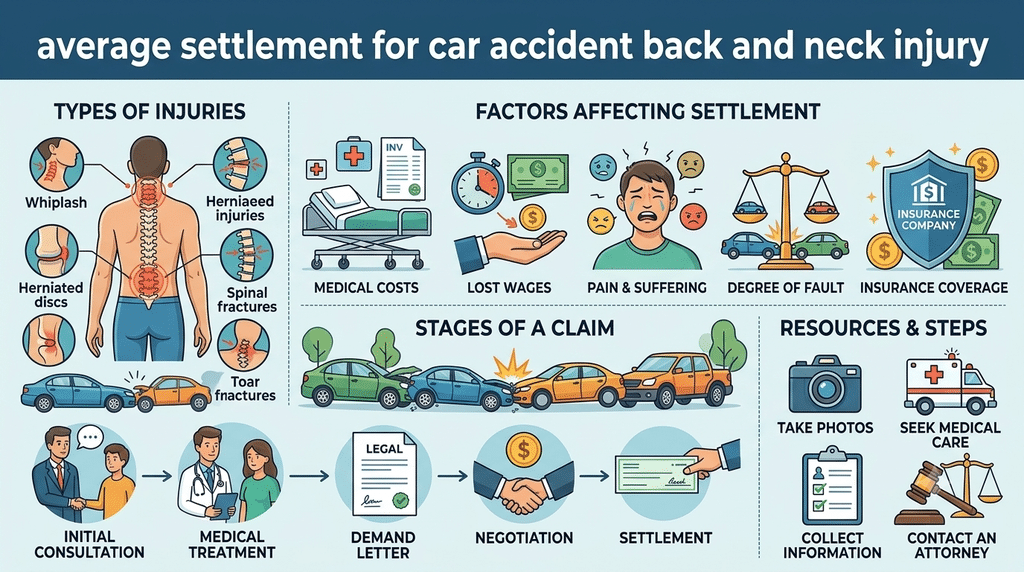
What Factors Influence a Car Accident Back and Neck Injury Settlement?
Settlement negotiations generally consider the strength of the evidence, the nature of the injury, the losses caused by the accident, and the risks of continued litigation.
A high medical bill does not automatically produce a high settlement. Similarly, a relatively modest bill does not always mean that an injury has little impact on a person’s life.
1. Severity of the injury
A temporary strain may resolve with conservative treatment. By contrast, a serious spinal injury may require specialist care, extended rehabilitation, or surgery.
The more substantial and well-documented the effects, the more closely the parties may examine future medical needs, functional limitations, and long-term financial consequences.
Nevertheless, severe symptoms must be supported by appropriate evidence, and the claim must satisfy the relevant legal requirements.
2. Medical treatment and recovery time
Treatment records help show how an injury developed and how it affected your recovery.
Relevant evidence may include:
- Initial examination findings.
- Follow-up appointments.
- Physical therapy records.
- Specialist recommendations.
- Prescribed medication.
- Medically indicated injections or other procedures.
- Records describing improvement, ongoing symptoms, or complications.
Follow your clinician’s recommendations rather than pursuing unnecessary treatment to influence a settlement. Treatment should address your medical needs, not serve as a strategy for increasing compensation.
3. Lost wages and reduced earning capacity
An accident may prevent you from working temporarily or permanently reduce your ability to earn income.
Keep copies of your pay statements, employer correspondence, attendance records, and medical work restrictions. If your injury affects your future earning capacity, additional vocational or financial evidence may help establish that loss.
Remember that no-fault lost-earnings benefits have limits. A separate claim may involve different legal rules and proof requirements.
4. Pain, discomfort, and daily limitations
A neck or back injury may interfere with driving, sleeping, lifting, exercising, childcare, or household tasks.
Describe these limitations accurately to your healthcare providers. You can also maintain a simple daily journal recording your symptoms, activities you could not perform, and changes in your recovery.
Contemporaneous notes may help explain your experience, although medical evidence and the legal requirements remain important.
5. Fault and available insurance coverage
Evidence showing how the crash occurred can affect the claim. Police reports, photographs, witness statements, and vehicle damage may help establish responsibility.
Insurance coverage also matters. New York’s minimum bodily injury liability limits generally include $25,000 for injury to one person and $50,000 for injuries to two or more people in one accident, subject to the statutory framework. Policies may carry higher limits.
The responsible party’s coverage, your own applicable coverage, and the number of injured claimants can affect the available recovery.
6. Pre-existing back or neck conditions
A previous injury does not automatically eliminate a claim. However, insurers may examine whether your current symptoms existed before the crash and whether the accident caused a new injury or aggravated an existing condition.
Tell your healthcare provider about your medical history. Accurate records help distinguish your prior condition from changes that occurred after the accident.
7. Consistency of the evidence
A well-supported claim connects the accident, the medical findings, the treatment, and the resulting losses.
Gaps in treatment, conflicting statements, or missing financial records may create questions. If a gap occurred because of cost, scheduling, or another genuine obstacle, explain it honestly and discuss it with your provider or attorney.
How Much Do You Get for a Neck Injury in a Car Accident?
The answer depends on the injury’s severity, the duration of symptoms, the financial losses, and whether the claim meets New York’s legal requirements.
A minor neck strain may lead to a different outcome from a cervical disc injury that causes persistent nerve symptoms or lasting functional impairment.
Mild neck strain and whiplash
Whiplash commonly refers to a neck injury associated with rapid movement of the head and neck. Symptoms may include stiffness, soreness, headaches, and reduced range of motion.
Some people recover with conservative treatment. Others experience symptoms that last longer and require additional evaluation.
For a settlement analysis, insurers may examine:
- How quickly symptoms appeared.
- Whether a clinician documented the injury.
- The length and nature of treatment.
- Whether symptoms interfered with work or daily activities.
- Whether the claim satisfies New York’s serious-injury requirements.
Do not assume that a rear-end collision automatically proves the full extent of your injuries. Likewise, do not assume that a normal initial X-ray rules out every soft-tissue or disc injury.
Cervical disc injuries
The cervical spine is the neck portion of the spine. A disc injury may cause local pain, stiffness, or symptoms that travel into the shoulder or arm.
An MRI may help identify disc abnormalities when a clinician considers imaging appropriate. However, imaging findings must be interpreted alongside the examination, symptoms, medical history, and other evidence.
The presence of a bulging or herniated disc alone does not establish the cause of the condition or determine the settlement value.
Is Your Car Accident Settlement Offer Fair?
Before accepting a settlement, understand how medical expenses, lost income, ongoing treatment, and pain and suffering may affect your claim. Our guide explains what New York accident victims should know about neck strains, back injuries, steroid injections, and insurance negotiations.
Read the complete guide to understand your rights and make a more informed decision.
Read the Settlement Guide
When neck injuries affect everyday life
Consider how the injury affects ordinary activities. Can you turn your head safely while driving? Can you work at a computer? Do you struggle to sleep or lift everyday objects?
Document real limitations and discuss them with your clinician. These details can help explain the injury’s practical effects more clearly than a diagnosis alone.
How Much Is a Neck Strain Worth?
There is no universal dollar amount for a neck strain. A fair evaluation requires evidence about the injury, treatment, recovery, financial losses, and applicable law.
A short-lived strain with minimal disruption differs from a documented injury that causes substantial limitations or qualifies under New York’s serious-injury threshold.
Example: a temporary neck strain
Imagine that a New York driver experiences neck soreness after a collision. A clinician diagnoses a strain, recommends conservative care, and documents gradual improvement.
The driver misses a few shifts and incurs medical expenses. The symptoms resolve without lasting limitations.
An insurer may evaluate this claim differently from one involving persistent symptoms, extensive treatment, and objective evidence of a qualifying injury. Depending on the facts, the first driver may have limited options for recovering pain-and-suffering damages under New York law.
This example is illustrative, not a prediction of a specific settlement.
Example: a neck injury with ongoing limitations
Now imagine a different driver who develops persistent neck pain after a collision. Specialist evaluations document restricted movement and symptoms that interfere with work and daily activities.
The medical record also contains findings that may support a qualifying serious injury.
That evidence could materially change the legal and financial evaluation. However, the outcome would still depend on causation, fault, coverage, damages, and the applicable law.
Why a diagnosis does not determine a dollar amount
A settlement is not calculated using a fixed price for each injury. The parties may evaluate medical expenses, lost earnings, future losses, non-economic damages when legally available, comparative fault, and insurance limits.
Therefore, ask for an evaluation based on your actual records rather than relying on an online neck strain settlement calculator that produces a number without reviewing your circumstances.
How Much Is a Back Injury Settlement After a New York Car Accident?
Back injuries range from temporary muscle strains to serious spinal conditions. Their effects can differ considerably, even when the initial symptoms appear similar.
The lower back, or lumbar spine, supports much of the body’s movement. An injury may affect bending, standing, lifting, walking, or sitting for long periods.
Lumbar strain and muscle injuries
A lumbar strain may cause localized pain and stiffness. Some people improve with conservative care, while others need additional treatment.
Important considerations include the recovery period, medical documentation, work restrictions, and whether the injury meets the legal threshold for non-economic damages.
A temporary strain does not automatically support a substantial pain-and-suffering claim under New York’s no-fault framework.
Herniated and bulging discs
A herniated disc occurs when disc material extends beyond its usual boundary. Depending on the location and other factors, it may irritate nearby nerves or contribute to pain.
A bulging disc is not necessarily the same as a symptomatic herniation. Some imaging findings exist without causing symptoms.
For that reason, a settlement evaluation should consider the complete clinical picture, not just an MRI report.
Spinal fractures and more serious injuries
A fracture or substantial spinal injury may require more extensive medical care. Some injuries also create long-term functional limitations or require future treatment.
Evidence about prognosis, ongoing care, rehabilitation, and work capacity may become particularly important.
If you have severe pain, new weakness, numbness in the groin area, or loss of bladder or bowel control after an accident, seek urgent medical evaluation. These symptoms can indicate a serious medical problem.
Do Steroid Injections Increase Settlement?
Steroid injections may play a role in treating certain back or neck conditions. However, steroid injections do not automatically increase a car accident settlement.
A settlement depends on the underlying injury, the medical justification for treatment, the evidence of accident-related harm, and the applicable legal and insurance rules.
Why might a doctor recommend an injection?
Depending on the diagnosis, a clinician may recommend an injection to reduce inflammation or help manage symptoms.
The treatment decision should reflect your medical needs. It should not be made solely because someone believes it will increase compensation.
Potential considerations include:
- The diagnosis and examination findings.
- Previous treatment and response.
- The expected benefits and risks.
- Other reasonable treatment options.
- Your clinician’s recommendations.
How can injection records affect a claim?
If an injection forms part of medically appropriate care, the records may help explain the nature of the condition and the treatment required.
The records should identify the medical reason for the procedure, the clinician’s findings, and the response to treatment.
However, the cost of a procedure does not translate directly into a particular increase in settlement value. An insurer may question whether the treatment was necessary, whether the accident caused the condition, and whether the injury satisfies New York’s serious-injury requirements.
Should you get an injection to increase compensation?
No. Do not undergo an invasive procedure solely to influence an insurance claim.
Discuss the benefits, risks, alternatives, and expected outcomes with a qualified healthcare professional. Keep accurate records of the treatment you actually receive.
A claim supported by appropriate medical care and honest documentation is more defensible than one built around unnecessary procedures.
What Is the Average Settlement for Neck and Back Injury?
The question combines two injuries that can have different causes, symptoms, and effects. When both occur in one accident, their combined impact may matter, but the injuries do not automatically produce two separate settlement amounts.
Combined neck and back injuries
A person may experience neck stiffness, lower back pain, headaches, restricted movement, and difficulty sitting or standing.
The overall evaluation may consider:
- Whether the injuries arose from the same collision.
- The duration and severity of symptoms.
- The medical evidence for each affected area.
- The impact on work and daily activities.
- The cost and expected duration of treatment.
- Whether a serious injury exists under the applicable statute.
- Available insurance coverage and any comparative fault.
A claim involving both neck and back injuries may be more complex than a claim involving one temporary strain. However, the number of injured body parts alone does not establish a higher value.
Why combined injuries need careful documentation
Make sure your healthcare provider knows about symptoms in every affected area. Do not focus exclusively on the most painful location if other symptoms also interfere with your recovery.
Consistent documentation helps establish the full clinical picture. It may also help identify whether symptoms relate to one injury, several injuries, or a pre-existing condition.
The ultimate settlement still depends on the complete evidence and applicable law.
How to Calculate Potential Car Accident Compensation
A useful starting point is to organize the losses associated with your injury. This exercise will not determine your legal settlement value, but it can help you identify missing information and understand your financial position.
Step 1: List your documented expenses
Include relevant expenses such as:
- Medical bills.
- Prescription costs.
- Physical therapy expenses.
- Travel to medical appointments.
- Other reasonable accident-related expenses.
Separate amounts already paid by insurance from amounts you still owe. Check for potential liens, reimbursement obligations, or other adjustments.
Step 2: Calculate lost income
Suppose your documented weekly income was $1,200 and you missed three weeks of work.
Your gross missed income would be:
$1,200 × 3 = $3,600.
This figure represents the initial wage loss before considering benefits, offsets, taxes, or other adjustments. It is not automatically the amount payable under no-fault insurance or a bodily injury settlement.
Step 3: Estimate future losses carefully
If a clinician expects you to need additional treatment, obtain a medically supported estimate where appropriate.
For example, if an eligible treatment costs $150 per visit and your clinician recommends eight visits, the estimated cost would be:
$150 × 8 = $1,200.
This calculation is only an illustration. Actual costs, medical necessity, insurance payments, and coverage terms may differ.
Step 4: Identify other potential damages
Depending on the legal requirements and facts, a claim may include eligible economic losses beyond those paid through no-fault benefits. Pain and suffering may be recoverable when the applicable serious-injury threshold is satisfied.
Avoid adding every expense and calling the total your settlement value. Some expenses may overlap, some may be covered elsewhere, and some may not be legally recoverable.
Step 5: Review insurance limits and legal issues
Even a detailed list of damages cannot predict the final result without considering fault, coverage, evidence, and the law.
For an individual claim, a qualified New York attorney can help assess the available recovery options and explain potential deductions or reimbursement obligations.
New York Car Accident Settlement Calculation: An Illustrative Example
Consider a hypothetical driver in New York who experiences neck and lower back symptoms after another motorist causes a collision.
Assume the driver has the following documented losses:
| Item | Illustrative amount |
| Accident-related medical expenses | $8,000 |
| Documented gross lost income | $3,600 |
| Transportation and other eligible expenses | $300 |
| Total listed economic losses | $11,900 |
The arithmetic is straightforward:
$8,000 + $3,600 + $300 = $11,900.
However, this total is not a settlement offer or a prediction of compensation. Some expenses may qualify for no-fault reimbursement, and others may require separate analysis. Insurance payments, offsets, liens, disputed charges, and coverage limits can affect the amount ultimately recovered.
If the driver also has a qualifying serious injury, a separate claim may include non-economic damages when the law permits. There is no universal formula that assigns a fixed dollar amount to pain and suffering.
Why a simple multiplier may be misleading
Some websites suggest multiplying medical bills by two, three, or another number to estimate a personal injury settlement.
That shortcut does not reliably predict New York car accident claim outcomes. It can ignore the serious-injury threshold, no-fault benefits, the medical evidence, future losses, available insurance, and comparative fault.
Instead, organize your actual losses and supporting documents. Then obtain an individualized assessment before deciding whether an offer fairly addresses the claim.
What Are Signs of a Good Settlement Offer?
A good settlement offer should be evaluated against the evidence and the likely outcome of the claim—not simply against the amount of your medical bills.
An offer may look attractive at first but leave important losses unresolved. Conversely, an offer that appears modest may reflect genuine weaknesses in the evidence or limited insurance coverage.
1. It accounts for documented losses
Review whether the proposed resolution addresses the losses that are legally recoverable in your case.
Check the treatment expenses, lost income, future medical needs, and other supported damages. Also review any amounts that insurance has already paid.
Do not assume that the offer includes every category of loss. Ask for a written explanation of how the insurer reached its figure.
2. It considers your medical progress
If you still need treatment or your prognosis remains uncertain, consider whether you have enough information to evaluate the long-term consequences.
Settling too early can create problems when the agreement releases future claims arising from the accident. In many cases, you cannot reopen a claim simply because your condition later worsens.
Discuss the medical outlook with your healthcare provider and the legal consequences with your attorney before signing a release.
3. It reflects the strength of your evidence
A reasonable evaluation considers the collision evidence, medical records, injury causation, functional limitations, and applicable legal standards.
It also considers weaknesses. For example, an insurer may dispute whether an MRI finding relates to the accident or whether an injury meets the serious-injury threshold.
Understanding these issues helps you assess the offer realistically.
4. It accounts for insurance coverage
Ask which policy applies, what limits are available, and whether other coverage may be relevant.
A strong injury claim does not necessarily guarantee full payment if the responsible party has limited coverage. Depending on the facts and policy terms, additional coverage may warrant investigation.
5. It explains deductions and final payment
Before accepting an offer, request a clear breakdown of any attorney fee, case expenses, medical liens, reimbursement obligations, and other deductions that may apply.
The settlement’s gross amount and your net recovery are not necessarily the same.
6. It gives you time to understand the agreement
You should understand what rights you release and whether the settlement resolves all claims arising from the accident.
Do not let pressure alone determine your decision. Ask questions, review the paperwork, and obtain legal advice when needed.
Gross Settlement vs. Net Settlement: What Will You Actually Receive?
The gross settlement is the total amount paid to resolve the claim. The net settlement is the amount that remains after applicable deductions.
These figures can differ substantially.
Example of a hypothetical settlement breakdown
Suppose an injured person receives a hypothetical settlement offer of $40,000.
The following example shows how deductions could affect the final amount. These figures are illustrative only and do not represent typical New York attorney fees or medical lien amounts.
| Item | Illustrative amount |
| Gross settlement | $40,000 |
| Hypothetical attorney fee | −$13,333 |
| Hypothetical case expenses | −$1,000 |
| Hypothetical medical lien or reimbursement | −$3,000 |
| Illustrative net recovery | $22,667 |
The calculation is:
$40,000 − $13,333 − $1,000 − $3,000 = $22,667.
Actual attorney fees depend on the agreement and applicable rules. Medical liens and reimbursement obligations also require individual review. The figures above should not be used as a quote for your case.
Questions to ask about your net recovery
Before signing a settlement agreement, ask:
- What attorney fee arrangement applies?
- Which expenses will be deducted?
- Are any medical providers claiming unpaid balances?
- Does an insurer have a reimbursement right?
- Will the settlement resolve every claim arising from the collision?
- What amount should I expect to receive after the deductions?
A written breakdown helps you compare offers on a more meaningful basis.
How Insurance Companies Evaluate Back and Neck Injury Claims
Insurance adjusters generally review liability, medical documentation, claimed expenses, coverage, and the potential risks of litigation.
Their job includes evaluating the claim for the insurer. Therefore, their initial assessment may not reflect every argument or item of evidence that supports your position.
Why might an insurer question your injury?
An insurer may ask whether the collision caused the symptoms, whether the treatment was necessary, and whether the medical evidence supports the claimed limitations.
For example, an MRI may reveal a disc abnormality, but the insurer may question whether it existed before the crash.
Your medical history and treating clinician’s findings can help address these questions. Provide accurate information and avoid exaggerating symptoms.
Why might the first offer be lower than expected?
The insurer may believe that the evidence supports a lower value. It may also dispute fault, the extent of the injury, or the amount of recoverable damages.
A low offer does not automatically mean bad faith. However, you should examine whether the offer accounts for the relevant evidence and applicable law.
Ask the adjuster to explain the evaluation in writing. Identify specific omissions or factual disagreements rather than responding with an unsupported demand.
Should you give a recorded statement?
Before giving a recorded statement to another party’s insurer, understand your rights and obligations. You may wish to consult an attorney, especially if you have significant injuries or the insurer disputes liability.
Always answer questions truthfully. Never guess about details you cannot remember.
Steps to Take After a New York Car Accident
Your actions after a collision can help protect your health and preserve important evidence.
Step 1: Seek appropriate medical care
Get prompt medical attention, particularly if you experience neck pain, back pain, headaches, numbness, or weakness.
Some symptoms may develop after the initial collision. Tell your clinician when the symptoms began and how the accident occurred.
Step 2: Report the accident and notify the insurer
Follow applicable reporting requirements and notify the appropriate insurance company promptly.
New York’s Department of Financial Services explains the rules for filing no-fault claims, including the general 30-day notice requirement. Review the official no-fault claim guidance.
Step 3: Preserve accident evidence
Keep copies of the following, when available:
- Police or collision reports.
- Photographs of the vehicles and scene.
- Contact details for witnesses.
- Insurance information.
- Medical records and bills.
- Work absence records.
- Correspondence with insurers.
Back up digital copies so that you can access them later.
Step 4: Follow your treatment plan
Attend appointments and follow appropriate medical advice. If you cannot attend an appointment, explain the reason and arrange follow-up care when possible.
Tell your clinician about continuing symptoms and new limitations. Accurate records are more useful than exaggerated descriptions.
Step 5: Track expenses and lost income
Keep a simple spreadsheet with the date, expense, amount, and supporting document.
For missed work, preserve pay statements, employer confirmation, and any required forms.
Step 6: Review deadlines
Different claims can have different filing requirements and deadlines. Do not assume that the no-fault notice deadline is the same as the deadline for a lawsuit.
For many New York personal injury actions, the general limitations period is three years, but important exceptions apply. Claims involving municipalities, public authorities, wrongful death, or other special circumstances may have different requirements.
Consult a qualified attorney promptly rather than waiting until a deadline approaches.
How to Choose a New York Personal Injury Attorney for a Back or Neck Injury
An attorney may help assess the evidence, explain the serious-injury threshold, communicate with insurers, and evaluate settlement options.
However, not every claim requires the same level of legal assistance. The appropriate decision depends on the injury, disputed issues, potential damages, and your circumstances.
What should you ask during a consultation?
Consider asking:
- Have you handled New York car accident claims involving similar injuries?
- How would you evaluate the serious-injury threshold in my case?
- What evidence would help establish causation and functional limitations?
- What insurance policies and limits should we investigate?
- How do your fees and case expenses work?
- What deductions could affect my net recovery?
- What are the risks of accepting an offer now?
- Which deadlines apply to my particular claim?
These questions help you compare attorneys based on their explanations and proposed approach rather than advertising promises.
Be cautious about guaranteed settlement claims
No ethical evaluation can guarantee a particular settlement before reviewing the facts and applicable law.
Be cautious if a service promises a specific payout, suggests that a procedure will automatically increase compensation, or pressures you to sign immediately.
Look for clear explanations, transparent fees, relevant experience, and a realistic discussion of both strengths and weaknesses.
New York Car Accident Claims in New York City and Other Major Areas
The same statewide insurance framework applies to many crashes across New York, but the facts of each collision can differ.
New York City
Crashes in Manhattan, Brooklyn, Queens, the Bronx, and Staten Island may involve congested streets, taxis, rideshare vehicles, commercial trucks, cyclists, and pedestrians.
Evidence may include traffic-camera footage, nearby business surveillance, witness accounts, and vehicle damage. Access to particular records depends on availability and applicable procedures.
Long Island
In Nassau and Suffolk counties, crashes may occur on busy highways, local roads, or residential streets. Collision reports, medical documentation, and evidence of how the crash happened may help establish liability.
Buffalo, Rochester, and Albany
Drivers in western and upstate New York may face different road conditions, including snow and ice. Weather conditions alone do not determine fault, but photographs, witness statements, road conditions, and driver conduct may help explain the collision.
Why location does not guarantee a particular settlement
An accident in New York City does not automatically produce a higher settlement than an accident elsewhere in the state.
The injury, medical evidence, legal requirements, available coverage, and circumstances of the collision remain central to the evaluation.
Common Mistakes That Can Harm a Back and Neck Injury Claim
Avoiding common mistakes can help preserve your options and reduce unnecessary disputes.
Accepting an offer before understanding your condition
A quick payment may seem helpful, particularly when bills are accumulating. However, a signed release can prevent you from pursuing additional compensation later.
Consider the medical outlook and the terms of the release before accepting a settlement.
Missing insurance deadlines
Late notice can jeopardize benefits. Submit the required information promptly and keep proof of submission.
If you believe you missed a deadline, seek advice immediately. Do not assume that the claim is automatically lost or that an exception necessarily applies.
Failing to document work losses
A verbal statement that you missed work may not provide enough evidence. Preserve pay records, attendance information, and employer documentation.
Exaggerating symptoms
Be accurate when describing pain and functional limitations. Inconsistencies can damage credibility and complicate the evaluation.
Ignoring medical reimbursement claims
Medical providers or insurers may assert liens or reimbursement rights. Understand these obligations before agreeing to a final distribution.
Relying on online settlement calculators
A calculator may not account for New York’s serious-injury threshold, no-fault rules, coverage limits, comparative fault, or the actual quality of the evidence.
Use calculators only as basic organizational tools, not as substitutes for an individualized assessment.
Conclusion: Understand Your Claim Before Accepting a Settlement
The average settlement for car accident back and neck injury is not a reliable prediction of what an individual New York claimant will receive. Your case depends on the injury’s severity, medical evidence, lost income, available coverage, and the legal requirements that apply.
Start by getting appropriate medical care, reporting the accident promptly, and keeping accurate records. Next, organize your expenses, treatment history, and wage losses. Finally, evaluate any offer in light of the evidence, the medical outlook, the applicable law, and potential deductions.
If your symptoms persist or the insurer disputes your claim, consider consulting a qualified New York personal injury attorney. A careful review can help you understand your rights, identify missing evidence, and make a more informed decision.
Before you sign a settlement release, make sure you understand what the agreement covers and which rights you may be giving up.
Useful next steps
- Review the New York no-fault insurance rules.
- Read the official New York serious-injury statute.
- Organize your medical expenses and lost-wage records.
- Speak with a qualified attorney if you need advice about your individual claim.
Legal disclaimer: This article provides general educational information, not legal, medical, or financial advice. It does not establish an attorney-client relationship or guarantee a settlement. New York law, insurance policy terms, and individual facts can change the outcome. Consult a qualified New York attorney for advice about your circumstances.
Sources and References
The following official resources support the legal and insurance information discussed in this article.
- New York State Department of Financial Services — Auto Insurance Resource Center. Explains mandatory auto insurance, no-fault benefits, coverage limits, and bodily injury claims.
https://www.dfs.ny.gov/consumers/auto_insurance/Auto_resource_center - New York State Department of Financial Services — Consumer Questions About No-Fault Insurance. Explains the general no-fault filing deadline and related claim procedures.
https://www.dfs.ny.gov/consumers/auto_insurance/nofault_faqs - New York State Senate — Insurance Law § 5102. Provides the statutory definitions used in determining whether an injury meets the serious-injury threshold.
https://www.nysenate.gov/legislation/laws/ISC/5102 - New York State Senate — Insurance Law § 5104. Addresses restrictions on recovering damages in motor vehicle personal injury actions.
https://www.nysenate.gov/legislation/laws/ISC/5104 - New York State Department of Financial Services — Filing Claims Under Your Own Policy. Provides practical information about insurance claims and no-fault documentation.
https://www.dfs.ny.gov/consumers/auto_insurance/filing_claims_under_your_own_policy - New York State Senate — Civil Practice Law and Rules § 1411. Explains how a claimant’s culpable conduct can reduce recoverable damages under New York’s comparative-fault rules.
https://www.nysenate.gov/legislation/laws/CVP/1411
Editorial and E-E-A-T note
This article explains the relevant rules using official state resources and clearly labels hypothetical calculations. It does not present invented client stories, fabricated settlement results, or unsupported settlement averages as verified facts.
For publication, consider having a New York-licensed personal injury attorney review the legal sections and update them when the law changes. If you add first-hand case examples, obtain permission where appropriate and identify whether the information comes from a public court record, a documented client experience, or a clearly labeled hypothetical.
Frequently Asked Questions About New York Back and Neck Injury Settlements
There is no dependable single average that predicts every New York claim. Settlement value depends on the injury, medical evidence, lost income, legally recoverable damages, fault, and available insurance coverage.
The amount varies by case. A temporary strain may be evaluated differently from a documented injury with lasting limitations. New York’s serious-injury threshold may also affect whether pain-and-suffering damages are available.
There is no fixed price for a neck strain. The recovery period, medical findings, financial losses, and legal requirements all affect the evaluation. Minor strains may not qualify for a separate pain-and-suffering claim under New York’s no-fault law.
Not automatically. Medically appropriate injections may provide evidence about treatment needs, but their cost does not guarantee a higher settlement. The underlying injury, medical justification, and applicable legal rules matter.
A good offer accounts for supported losses, the medical outlook, applicable insurance coverage, legal risks, and potential deductions. It also comes with clear terms that you understand before signing a release.
Generally, no. Basic no-fault benefits cover eligible economic losses. A separate claim for pain and suffering usually requires an injury that meets New York’s statutory serious-injury threshold.
New York generally requires written notice of a no-fault claim within 30 days, subject to applicable exceptions. Other reporting duties and lawsuit deadlines may differ, so contact the relevant insurer and seek legal advice promptly.
Don’t Overlook Important Costs After a Back or Neck Injury
Your accident-related losses may extend beyond your initial medical bills. Future treatment, missed work, and lasting physical limitations may also matter, depending on the facts and applicable law.
Discover how to organize your records, evaluate an insurance offer, and understand the factors that influence the average settlement for car accident back and neck injury in New York.
Take the next step: review your documentation and explore your legal options before signing a settlement release.
Understand Your Claim

Karthick is the Founder of Wandersure Coverage, a travel and insurance-focused blog helping global travelers make smarter decisions.
Based in Chennai, India, Karthick has several years of experience researching international travel, travel insurance policies, and legal resources such as accident attorneys in the United States. He has published 700+ articles covering travel packages, insurance guides, and trip planning tips.
While not a licensed insurance broker or attorney, Karthick spends extensive time analyzing policy terms, coverage details, and real-world travel scenarios. His goal is to simplify complex information into clear, practical advice so travelers can stay protected and travel with confidence.
He regularly updates content to reflect the latest travel rules, insurance policies, and legal guidelines for international travelers.